

“In American hospitals alone, healthcare-associated infections (i.e., nosocomial infections) account for an estimated 1.7 million infections and 99,000 associated deaths each year. Of these infections: 32 % of all healthcare-associated infection are urinary tract infections; 22 percent are surgical site infections; 15 percent are pneumonia (lung infections); and 14 percent are bloodstream infections” (Centers for Disease Control and Prevention Report, 2007).
Bacterial Biofilms- The Dark Side
One can but imagine the devastating effect of biofilms on healthcare. Nosocomial (hospital-acquired) infections and debilitating chronic infections are on the rise, with biofilms being the eye of the hurricane. The search for biofilm disrupting agents, anti-biofilm substances and anti-quorum sensing compounds are being vigorously searched for, while a team lead by Dr. Srinandan C S and Dr. Subbiah Nagarajan from SASTRA University, India, have found a surprisingly elegant method.
A collaboration between two teams, the first led by Dr. Subbiah Nagarajan, synthesized a glycolipid based surfactant which when tested by Dr.Srinandan’s team, efficiently disrupts a multitude of disease causing bacterial biofilms. Though similar amphiphilic compounds have been tested earlier, this surfactant group is easy to synthesize and has shown promising results when tested with biofilms of Staphylococcus aureus, Listeria monocytogenes, uropathogenic E. coli and Salmonella enterica Typhimurium, which are all notorious microbes. An interesting fact to note here is that the surfactant was synthesized from renewable feedstocks, adding another feather to the hat.
Studying the Compounds’ Characteristics
Amphiphilic surfactants have varied uses, including drug delivery, polymers and in detergents. Unlike many amphiphilic surfactants, compounds 6a and 6c (the glycolipid compounds synthesized) are simple to generate and self-assemble under hydrophobic conditions, forming a gel-like consistency. Whereas in water, the compounds form foam. The group synthesized three compounds, 6a, 6b and 6c from renewable feedstocks. They then studied various properties of the compounds using techniques such as HRTEM (High Resolution Transcription Electron Microscopy), envisaged the structure using NMR (Nuclear Magnetic Resonance) and the behavior of the various compounds as surfactants. The group found that compounds acted as surfactants, due to their structure and presence of certain groups.
Exploring the Biofilm Terrain
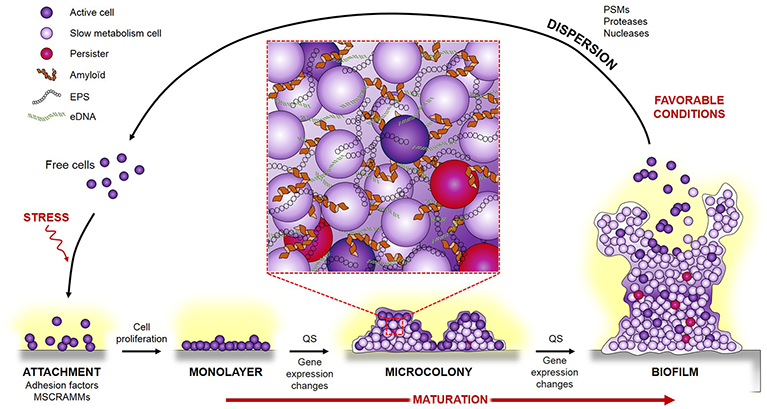
Biofilms are highly complex and dynamic lifestyles exhibited by bacteria. They form in stages, as shown above. The biofilm consists of an extrapolymeric substance (EPS) that consists of various sugars, proteins and sometimes, extracellular DNA. While eradicating biofilms with antimicrobials has been a difficult task, disrupting biofilms before treatment has proven an excellent strategy, amongst other options such as anti-quorum sensing compounds and bio-based surfactants.
The group showed how the supramolecular assembly of the glycolipid surfactant affected the pathogenic biofilms. They tested the compounds in various situations: whether the compounds inhibited formation of biofilms, whether they disrupted pre-existing biofilms and if the compounds interfere in the polymeric substances that consist the biofilm.
The experiments conducted, involved using the compounds and comparing it to surfactants such as SDS and disruptors such as CTAB. The results of the various experiments to test these effects showed significant inhibitory and disrupting actions of the self-assembling compounds. 6a disrupted Gram-positive L. monocytogenes and S. aureus biofilms, while 6c disrupted those of Gram-negative S. Typhimurium and E. coli significantly.
“The study is exciting because it is a double-edged sword- the study focusses on ‘Waste to Wealth’ and this ‘Wealth’ is oriented towards health” – Dr. Srinandan C S
This work gives rise to possible uses of these compounds in clinical settings and in the food industry, two areas where biofilms wreak havoc. Clinicians washing their hands before tending to patients, surface cleansing in medical settings and in eradicating existing biofilms in food processing units are but a few of the possible applications of this novel surfactant! As William Osler once said, ‘Soap, water and common sense are the best disinfectants’, this study proves to be its perfect extension, indeed!
Read more about this here.
(Featured image source: Here)
Ananya.N.S ©

 Ananya Nidamangala Srinivasa